

History After Dark · Explore the episode
Ten feared pirates. Ten surprising facts.
A medicine ransom. A pirate hunter turned defendant. A fleet commander who negotiated her own retirement. Meet ten notorious pirates and buccaneers whose lives were stranger, and often darker, than the legends.
Blackbeard · Charleston · 1718
Blackbeard's ransom was a chest of medicine
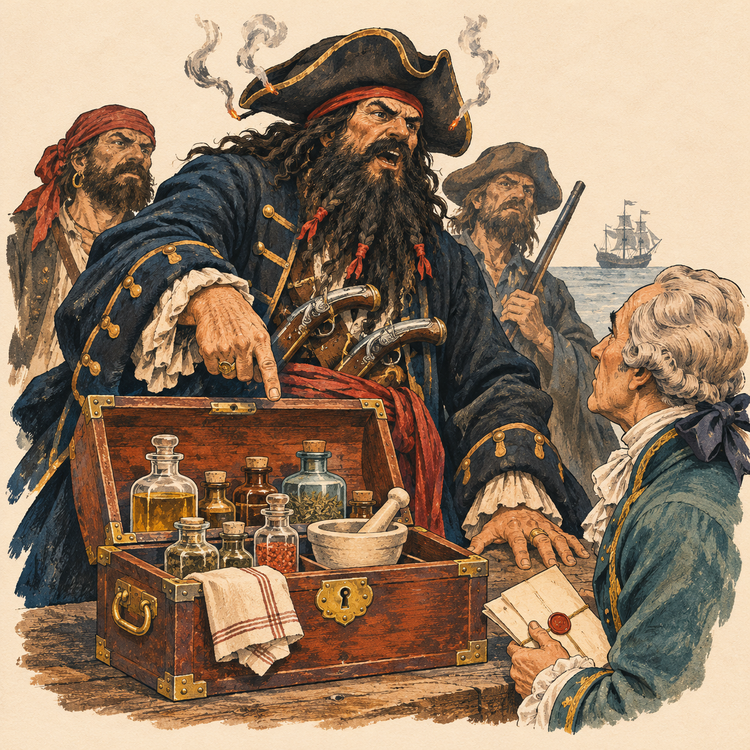
In May 1718, Blackbeard's ships stopped vessels entering and leaving Charleston. His men seized passengers and held them hostage. The demand that followed was unexpectedly practical: a chest of medicines. The authorities were being threatened by one of the Atlantic's most notorious pirates, and the immediate price of releasing the captives was medical supplies.
Among the prisoners were the merchant Samuel Wragg and his young son. Charleston Museum describes the capture of nine vessels during the blockade. The hostages faced a threat of death if the demand was refused. Once the medicines arrived, they were released, although they had also been robbed. This was coercion backed by the ability to hurt people, even when the object being demanded was something as ordinary as medicine.
Blackbeard had acquired his powerful flagship by capturing the French slave ship La Concorde in 1717 and renaming it Queen Anne's Revenge. That kind of firepower made his threats credible. The Charleston episode shows a side of piracy that treasure maps leave out: a ship needed supplies as well as loot, and a port's civilian traffic could be turned into bargaining power.
The negotiations involved a particularly uncomfortable journey ashore. In Charles Johnson's account, published six years later, a pirate commander named Richards went into Charleston with other pirates and a captive called Mr Marks. Marks was to put the demand before the authorities. The pirates' message included threats to kill the prisoners and burn the captured vessels if their demands were refused or their messengers were harmed. The people sent to collect the ransom were therefore protected by the danger facing people elsewhere.
Johnson describes Richards and his companions walking openly around the town while Marks dealt with the council. Whether every detail of that scene is reliable, it captures the disturbing logic of hostage-taking. Arresting the men within reach could endanger captives who were still aboard the ships. Charleston's officials had to consider the consequences of resistance, not merely whether they had enough men to seize a few pirates standing in their streets.
Nor was the medicine chest a replacement for ordinary robbery. Johnson says the pirates also took money and provisions before releasing the vessels. The supplies were the specific condition imposed on the town, while passengers and cargo remained sources of plunder. That distinction makes the incident more revealing: Blackbeard was using several forms of pressure at once, taking portable wealth from his captives while making the authorities supply something his fleet wanted.
It is tempting to turn the medicine chest into a diagnosis of the crew. We cannot confidently do that. The demand tells us what Blackbeard wanted from Charleston, but does not establish precisely who needed treatment or which illnesses were involved. The surprising fact is strong enough without adding an unsupported medical explanation.
↑ Back to the ten factsZheng Yi Sao · South China Sea · 1810
Zheng Yi Sao retired through negotiation

Not every powerful pirate ended on a scaffold or at the bottom of the sea. Zheng Yi Sao helped lead a formidable pirate confederation in southern China, then negotiated a surrender in 1810. Her career ended with an agreement rather than a final, hopeless stand aboard a burning ship.
After her husband Zheng Yi died in 1807, she became a central figure in the confederation's leadership, working with the commander Zhang Bao. This was a network of fleets, not a single ship with a colourful captain. Its scale required alliances, coordination and negotiation as well as force. Treating every person in that network as someone she directly commanded can blur how the organisation actually worked.
Historian Nathan Kwan records a surrender involving 17,318 men, women and children, along with 226 ships. That is a count of people in the surrendering community, not a precise total of fighting sailors or everyone who had belonged to the wider confederation at its peak. Larger numbers often circulate online, but they do not necessarily measure the same thing.
The settlement came as the wider alliance was beginning to break apart. An Oxford case study describes squadrons surrendering from January 1810, before Zheng Yi Sao and Zhang Bao reached their own agreement. Rivalries between leaders helped make government offers attractive. A confederation could be formidable at sea and still vulnerable to members deciding that their interests were better served elsewhere. Negotiation became possible partly because the political situation inside the pirate alliance was changing.
The bargaining was not straightforward. The same study describes a dispute over how many vessels the commanders could keep, with talks interrupted before agreement was reached. The April settlement involved handing over hundreds of ships and more than a thousand cannon. Zhang Bao subsequently entered imperial military service. The government was therefore removing a threat while gaining the experience of someone who understood the coast and the people operating along it.
Historian Nathan Kwan also places the surrender within a wider campaign involving naval pressure, restrictions on coastal support and offers of pardon. That combination helps explain why an agreement could succeed where a simple demand to give up might fail. Zheng Yi Sao's retirement was neither an effortless victory over the government nor a conventional battlefield defeat. It was an exit secured while she still had enough influence to negotiate the terms.
Zheng Yi Sao was about 35 when she left piracy. She later operated a gambling business. That change of occupation is what makes the ending so striking: someone associated with an enormous maritime threat lived beyond her pirate career and entered a different kind of business. Her influence lay partly in knowing when an agreement could achieve more than continued fighting.
↑ Back to the ten factsBartholomew Roberts · Atlantic Ocean · 1719 to 1722
Roberts was credited with over 400 captures
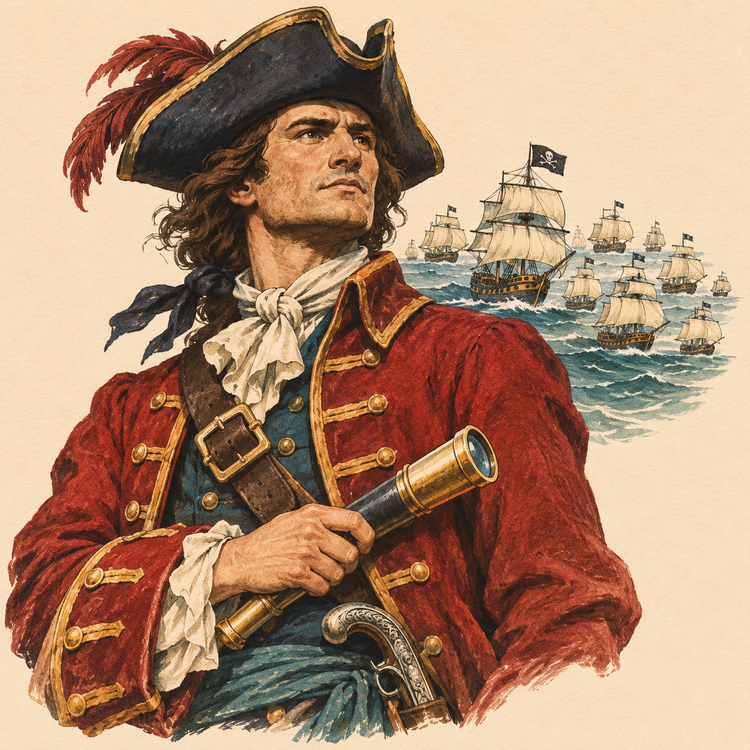
Blackbeard may have the more recognisable name, but Bartholomew Roberts was credited with an extraordinary total of more than 400 vessels taken during a pirate career lasting less than three years. Royal Museums Greenwich describes him as the most successful pirate of the so-called Golden Age by that measure.
The number needs a little care. It is a historical tally, not a modern, independently audited list of 400 major warships defeated in battle. A captured vessel might be a much smaller craft, and a capture did not necessarily involve prolonged fighting. Counting ships also tells us nothing by itself about the value of their cargoes or the suffering inflicted on the people aboard them.
The scale of the claim is not a recent internet invention. Charles Johnson's A General History of the Pyrates, published in 1724, credited Roberts and his crew with taking 400 sail. That early printed account helped fix the total in pirate history. Johnson remains an important source, but his colourful writing should not be mistaken for a neutral modern database.
Johnson gives Roberts an unexpectedly rapid rise. He had been serving aboard a merchant vessel when Howell Davis's pirates took it, and the account says he was initially forced into their company. After Davis was killed, the pirates elected Roberts captain even though he had been with them for only about six weeks. If accurate, that is a remarkable transition from captured seaman to the leader whose name would become attached to hundreds of captures.
The same book preserves rules attributed to Roberts's company. They required weapons to be kept ready for use, prohibited gambling for money and set out shares of plunder for different officers. One rule ordered lights and candles extinguished at eight in the evening, with anyone still drinking sent onto the open deck. These are the details of an organisation trying to control the practical problems of crowded life aboard ship, even while making its living through violent theft.
Another rule provided compensation from the common funds for serious injuries. It is an arresting contrast: men who preyed on outsiders could make arrangements to share certain risks among themselves. None of this made their activities benevolent. It does help explain why a successful pirate company needed more than an intimidating captain. Keeping sailors armed, dividing proceeds and settling disputes were all part of sustaining a crew capable of repeatedly taking other vessels.
Roberts was killed in February 1722 near Cape Lopez, in what is now Gabon, during an encounter with the Royal Navy's Swallow under Chaloner Ogle. His death brought an abrupt end to a career that had ranged across the Atlantic. The useful comparison is not that he was objectively the most frightening pirate, which cannot be measured, but that his recorded rate of captures was exceptional.
↑ Back to the ten factsSamuel Bellamy · Cape Cod · 1717 / 1985
Bellamy's ship was identified by its own bell
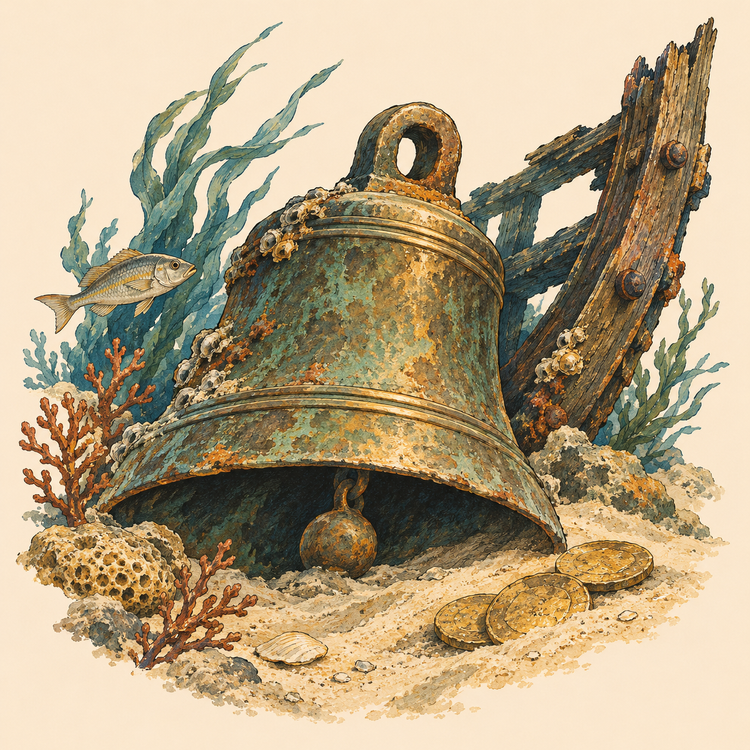
A shipwreck can yield cannons, coins and timber without immediately revealing its name. In the case of Samuel Bellamy's flagship, the Whydah Gally, a recovered bell supplied unusually direct evidence. It carried the vessel's name and the date 1716. The bell was recovered in 1985, after the wreck site had been located the previous year.
Bellamy had captured the Whydah in early 1717. Before becoming a pirate flagship, it had been a slave ship. That earlier role matters: the vessel's wealth and movements belonged to the brutal Atlantic slave trade before they became part of Bellamy's pirate career. Its history cannot be reduced to a romantic search for lost treasure.
The Whydah sank in a storm off Cape Cod on 26 April 1717. Bellamy died in the wreck, and only two people aboard survived. The force that destroyed the ship was weather, not a victorious naval opponent. A heavily armed vessel and a successful captain were still vulnerable to the coast, the seabed and a severe storm.
The objects also widen the picture beyond spectacular treasure. Conservators who assessed the Whydah collection recorded padlocks, tools, kitchen equipment, navigational instruments and pieces of the vessel alongside weapons and precious metals. Such finds point towards the work that continued between attacks. People still had to prepare food, maintain equipment and find their way across the sea. The wreck preserves traces of that ordinary labour as well as the violence that makes its former crew famous.
Getting those objects out of the water was only one stage of the process. The conservation assessment distinguished between items already treated and others still undergoing desalination. An object can survive underwater for centuries and then require careful treatment after recovery. The researchers' task therefore involves more than recognising an exciting find: recording, stabilising and preserving it makes it possible for other people to study it later.
The inscription is especially helpful because resemblance alone would leave more room for doubt. A cannon might fit several ships of the period; a bell bearing a vessel's name offers a much more specific connection. Even then, the date on the bell is not the date of the wreck or of its discovery. Keeping those separate gives the object its real value: it helps connect an archaeological site with a particular ship, rather than supplying every detail of what happened aboard it.
The modern investigation has recovered a large collection of objects, including weapons, coins and personal belongings. The bell did something particularly valuable: it connected a physical wreck to a named vessel. These finds let researchers ask questions that written accounts alone cannot answer. A pirate's reputation may be built from testimony and printed accounts; an inscribed object provides a different kind of evidence.
↑ Back to the ten factsHenry Every · Indian Ocean · 1695
Every's raid became an international crisis
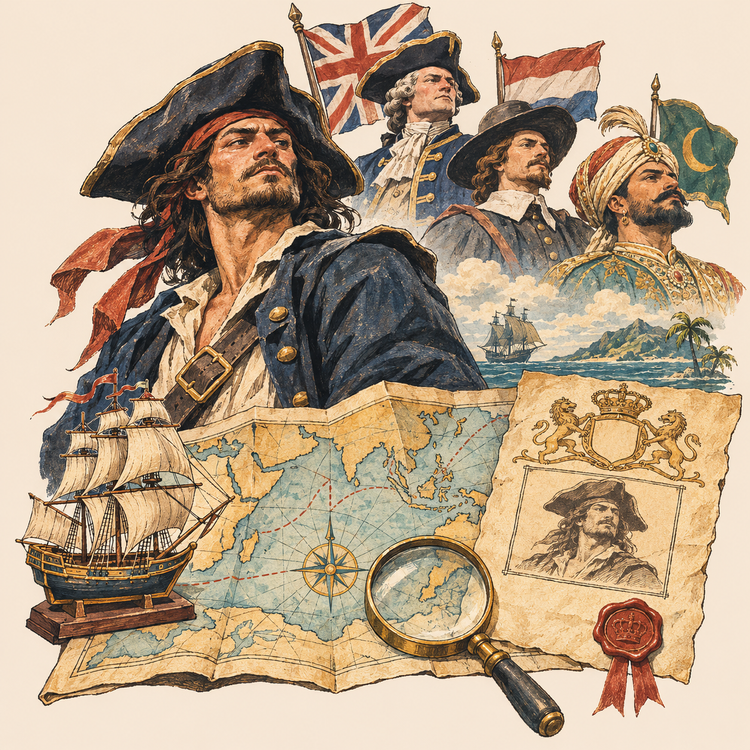
Henry Every's attack on the Mughal ship Ganj-i-Sawai in 1695 did more than enrich a pirate crew. It provoked an international pursuit and threatened English commercial interests in India. A robbery at sea could produce consequences far beyond the people who had planned it.
The attack was exceptionally violent. Accounts describe murder and sexual violence against those aboard. Any description of the captured wealth needs to keep those victims in view. The episode was not simply an audacious theft followed by a clever getaway; it involved an assault on people whose lives were treated as expendable.
The British Library's India Office records preserve traces of the official response. Its catalogue lists an East India Company petition dated July 1696 seeking protection for trade against Every, alongside material connected with a proclamation against him. These records show the alarm reaching institutions concerned with commerce and government, rather than remaining an isolated complaint from a robbed captain.
A proclamation issued in Edinburgh on 18 August 1696 shows how that pursuit worked in practice. It identified Every under the alternative name Bridgeman and offered £500 for securing him. Smaller rewards of £50 were offered for named accomplices. Listing other crew members mattered: a dispersed company could be pursued through many people, rather than through a search for one famous captain alone. The authorities wanted names, arrests and information that could lead them to the fugitives.
The proclamation also supplied a possible clue. It warned that suspects might possess substantial quantities of Indian or Persian gold and silver. Money taken far away could become conspicuous when carried into another country. This was not proof that every owner of an unfamiliar coin was a pirate, but it shows officials trying to turn the proceeds of the raid into something local people could recognise and report.
Orders went to civil and military officers, and the proclamation was to be printed and announced publicly at market crosses. People were forbidden to shelter the fugitives. The document also reported a belief that members of the company had reached Scotland, which should not be confused with proof that Every himself was there. It is a vivid surviving example of a search spreading through notices, rewards and local officials, long before police could exchange photographs or electronic records.
Every escaped capture, and his ultimate fate remains uncertain. That gap has invited imaginative endings and repeated claims that the mystery has finally been solved. The secure point is narrower and more interesting: one pirate raid helped generate a pursuit across national and commercial networks. His disappearance should remain an open question, rather than an excuse to give him an invented retirement.
↑ Back to the ten factsWilliam Kidd · London / Indian Ocean · 1690s
Captain Kidd began with a pirate-hunting commission
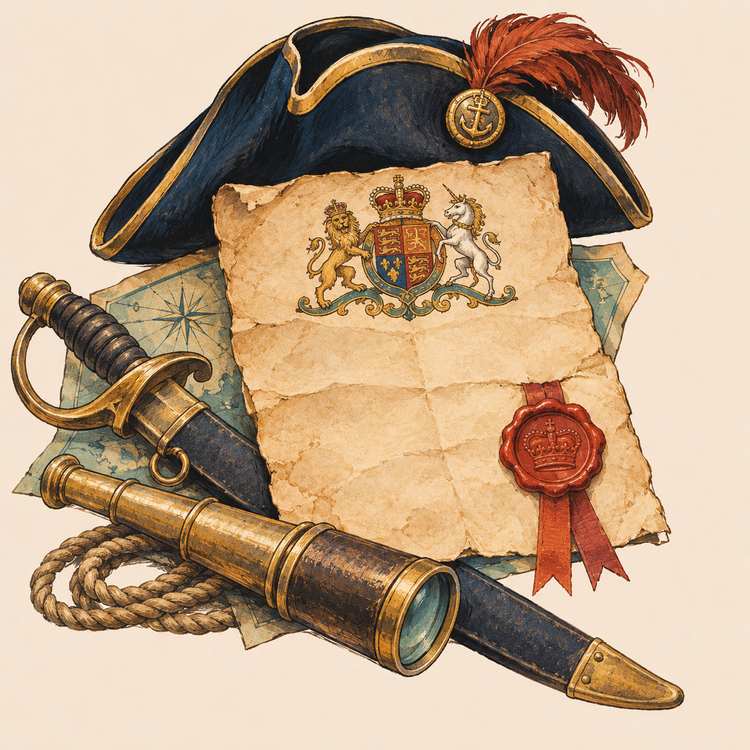
William Kidd did not begin his final voyage simply by declaring himself an outlaw. He sailed with official commissions authorising him to suppress piracy and to attack French shipping. The man later executed as a pirate had been entrusted with pursuing pirates himself.
That distinction helps explain a world in which armed private ships could operate with government permission. A privateer was authorised to attack specified enemies under particular conditions. A pirate acted outside that authority. A commission was not unlimited permission to seize whatever looked profitable, and arguments about a ship's status could become matters of life and death.
Kidd was arrested in Boston in 1699 and sent to England. He was eventually convicted of piracy and murder. At his trial, he referred to his commission and to French passes connected with captured shipping. The surviving proceedings make it possible to see how questions of documentation, permission and conduct were argued in court, rather than treating his career as a simple change of costume from respectable captain to villain.
The printed account of his 1701 trial even includes the two commissions, allowing readers to compare the authority he received with the conduct alleged against him. That is a useful way into the case. The important question was not simply whether Kidd possessed impressive official papers. It was whether those papers covered a particular action against a particular vessel. Permission to fight one country's shipping did not make ships of every other country legitimate targets.
A separate charge concerned the death of his gunner, William Moore, aboard the Adventure Galley. Witnesses described Kidd striking Moore with an iron-bound wooden bucket after an argument, with Moore dying the following day. Kidd tried to connect the confrontation with pressure from the crew to seize another vessel. The court questioned witnesses about that explanation, including whether a mutiny was actually taking place when the blow was delivered.
This part of the proceedings is easily lost when attention centres on disputed prizes and missing documents. Yet it was a distinct accusation about a man's death, not merely another argument about the nationality of a captured ship. Reading the exchanges gives the case a more human scale: a captain defending his decisions, sailors offering testimony and judges asking what happened during one confrontation on deck. The commission explains how Kidd began the voyage; it cannot by itself explain away everything that happened afterwards.
His case has attracted competing interpretations ever since. It is reasonable to recognise that politics and contested evidence formed part of the proceedings. It is not reasonable to turn that complexity into a confident declaration that every accusation was fabricated. The remarkable fact is that the state could authorise a voyage against pirates and later prosecute its commander as one.
↑ Back to the ten factsAnne Bonny · Bahamas / Jamaica · 1720
Anne Bonny was already a wanted woman
Anne Bonny is often imagined as a pirate whose identity remained a secret beneath men's clothing until a dramatic final discovery. But a September 1720 proclamation named both Anne Bonny and Mary Read as women associated with John Rackham's crew, before their capture. The authorities were not waiting for a last-minute revelation to learn that women were aboard.
The Library of Congress's account of Bonny's trial draws attention to evidence from people attacked by the crew. Dorothy Thomas, who had been travelling in a canoe, identified the women and described their armed involvement. The court material gives us something firmer than a later romantic biography: testimony about particular acts attributed to Bonny during the crew's raids.
Clothing still matters, but it should not be made to carry more meaning than the evidence supports. Trousers and practical seafaring clothes could be useful aboard a working vessel. Wearing them did not necessarily mean that a person's identity was unknown to companions or officials. Royal Museums Greenwich specifically cautions against assuming that Bonny and Read's clothing always amounted to a successful disguise.
The printed trial makes Thomas's account more unsettling than a simple description of unusual clothing. She said the crew took most of the goods from her canoe and that both women carried pistols and cutlasses. She also accused them of urging the men to kill her so she could not testify against them. This is testimony recorded by the court, rather than a conversation we can independently reconstruct, but it puts a frightened civilian at the centre of the encounter.
Other witnesses described the women helping with shipboard work and supplying gunpowder during an attack. Their evidence concerned what Bonny and Read did as part of the company. It is a useful corrective to treating them as decorative exceptions in a largely male setting. The prosecution presented them as working participants in an armed crew, with responsibilities that went beyond simply being passengers on a pirate vessel.
The charges also reveal the modest scale of some targets. They included an attack on fishing boats and the theft of fish and fishing tackle. These were not all encounters with grand treasure ships. For the people robbed, losing equipment and supplies could threaten a livelihood. Looking at those details brings Bonny's reputation into focus: whatever later writers added to her personality, the surviving proceedings connect her with raids against people carrying out everyday work at sea.
Bonny was tried in Jamaica in November 1720 and convicted. Much about her early life and later fate is less secure. That uneven evidence is part of the interest: a few surviving records can establish that she participated in piracy while leaving many of the details that make popular biographies so vivid unresolved.
↑ Back to the ten factsMary Read · Jamaica · 1720 to 1721
Mary Read's pregnancy plea halted her execution
After Mary Read was convicted of piracy in Jamaica in 1720, she pleaded that she was pregnant. Her execution was delayed. Anne Bonny made the same plea after their trial. This was not an acquittal, and it did not erase the convictions: it interrupted what would otherwise have followed a death sentence.
The distinction matters because popular retellings sometimes turn the pregnancy pleas into a successful escape from the legal system altogether. The court's response concerned the timing of punishment. Read remained in custody, and records place her death in prison in 1721. She avoided the gallows, but she did not gain a long, documented life of freedom.
Modern research on the trial looks closely at the testimony and the legal language surrounding the two women. Witnesses portrayed them as active participants, rather than people merely present aboard the ship against their will. The proceedings therefore offer evidence both of their participation in piracy and of the legal mechanism used to delay their executions.
The sequence recorded in the printed proceedings is important. Read and Bonny were tried together on 28 November 1720 at St Jago de la Vega, now Spanish Town. They pleaded not guilty, the court heard witnesses, and the commissioners found them guilty. Only after sentence had been pronounced did the pregnancy pleas appear. The request concerned whether execution should proceed, rather than whether the earlier verdict should be reversed.
The record says the women claimed to be 'quick with child', an older expression referring to pregnancy at the stage when movement could be felt. The court ordered a respite and an inspection. That brief entry gives us a concrete legal action without explaining everything that followed. It does not supply a detailed account of either pregnancy, and it should not be stretched into a fully documented account of a birth, a release or a later family life.
There is also a revealing contrast between the different kinds of surviving material. The trial records questions about participation, witnesses and punishment. Johnson's later book tries to supply a much fuller personal biography. The fuller account may be more entertaining, but extra detail is not automatically stronger evidence. For Read, the short court entry is enough to show how a last intervention changed the immediate outcome of the trial, even though it did not ultimately save her life.
Much of Read's supposed earlier life, including elaborate accounts of military service and concealed identity, comes through Charles Johnson's 1724 publication. Those episodes should be distinguished from the trial record. The best-supported surprise is already striking: a pirate convicted alongside her crewmate could invoke pregnancy to postpone execution, yet still die behind bars before the question of a later execution arose.
↑ Back to the ten factsHenry Morgan · Caribbean · 17th century
Morgan's reward included a knighthood

Henry Morgan's career ended very differently from those of many Atlantic pirates. The man associated with devastating raids against Spanish settlements was knighted and became lieutenant governor of Jamaica. A reputation built through maritime violence could lead to official status when that violence served the interests of a colonial power.
Morgan belongs in this discussion as a buccaneer and privateer, rather than as an uncomplicated example of an outlaw operating against every government. Smithsonian Ocean describes his activities on behalf of Jamaica and his attacks on Spanish ships and towns. To understand his rise, it is necessary to ask who authorised or benefited from a raid, not just whether armed men seized property.
That official connection did not make the raids humane. The Smithsonian account notes killing and torture. A title bestowed afterwards does not cancel what happened to the people subjected to those attacks. Morgan's career exposes how easily familiar categories such as criminal, military ally and respectable official can overlap when viewed from different sides of an imperial conflict.
His attack on Panama in 1671 makes the reversal particularly striking. Morgan led a force across the isthmus and captured the city, extending the reach of his raiding well beyond attacks on vessels at sea. The expedition's political timing was disastrous: England and Spain had agreed a peace treaty in 1670. Raids that might previously have been useful to English officials now risked becoming a serious diplomatic embarrassment.
Morgan and Jamaica's governor, Thomas Modyford, were ordered to England to answer for their conduct. That might sound like the beginning of a familiar pirate's final chapter. Instead, Morgan gained royal favour. In 1674 he received his knighthood and appointment as lieutenant governor. The contrast is not just between two labels, pirate and official. It is between being called to account for a violent expedition and returning to the Caribbean with a position in the colonial government.
Lieutenant governor also needs to be distinguished from the claim that Morgan simply became the permanent governor of Jamaica. It was a particular office within an administration, not ownership of the island or unlimited authority over it. His later career included disputes with other officials, suspension from office in 1683 and restoration to the council shortly before his death in 1688. Respectability did not bring an uncomplicated ending; the former raider remained entangled in the politics of the colony he had helped defend and enrich.
The surprising point is not that every pirate could become a governor by accumulating enough money. Morgan's political usefulness and particular circumstances mattered. His later honours show that the boundary between condemned raiding and rewarded service was shaped by power as well as conduct. The same acts that made a commander terrifying to one population could make him valuable to another government.
↑ Back to the ten factsStede Bonnet · Barbados / Carolinas · 1717 to 1718
Bonnet bought a ship to become a pirate
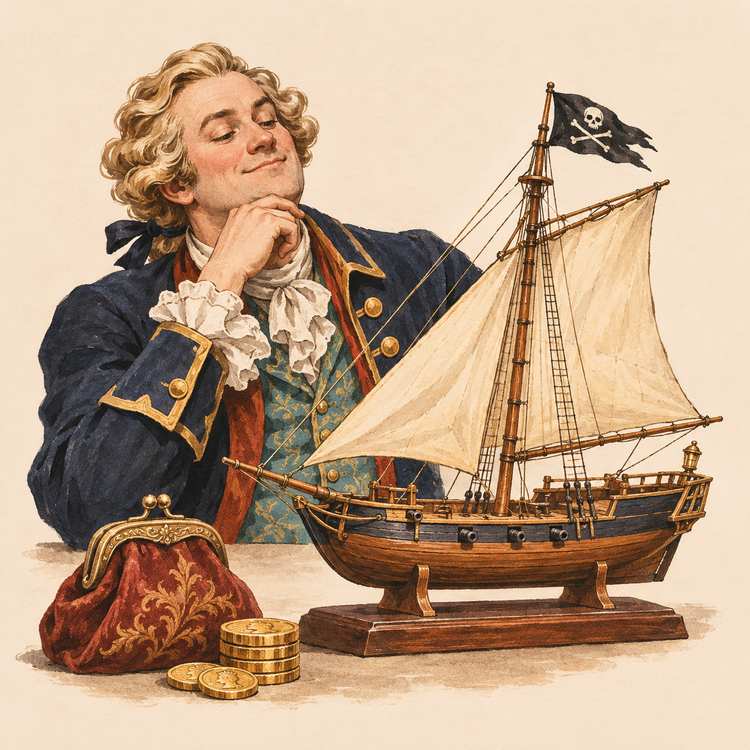
Stede Bonnet did not need to capture his first pirate vessel. In 1717, he bought and armed a sloop called Revenge, recruited a crew and went to sea. He came from the wealthy planter class in Barbados and had served in the island's militia. Piracy was a departure from an established position, not his only apparent route out of poverty.
The Library of Congress describes the Revenge as carrying ten guns and a crew of about seventy. Bonnet's resources gave him the means to begin, but they did not automatically provide the experience needed to command successfully at sea. After a damaging encounter with a Spanish warship, his career became entangled with Blackbeard's.
Bonnet later received a royal pardon, then returned to piracy under assumed names. In September 1718, forces commanded by William Rhett captured him after a battle in the Cape Fear River. He escaped from custody, was recaptured and was executed in Charleston that December. Buying the vessel had been the easy part; controlling the consequences proved impossible.
The later stages of his voyage show how quickly an expensive vessel could become a liability. Johnson's account describes Bonnet's sloop, by then renamed Royal James, leaking badly enough to require an extended stay in the Cape Fear River. The pirates took apart a smaller captured craft to obtain material for repairs. A captain might buy guns and recruit men, but he still depended on the condition of the hull beneath them.
The delay gave his opponents time to act. When William Rhett's expedition arrived, the pirates found themselves facing armed vessels in restricted water. Johnson describes both sides running aground during the engagement. The resulting fight depended on the position of the stranded ships and the changing water level, rather than on a clean chase across an open sea. It is a useful reminder that tides and shoals could be as decisive as courage or the number of guns aboard.
Those practical difficulties make the initial purchase more interesting. Money could obtain a platform for piracy, but it could not remove the need for navigation, repairs, supplies and sound decisions under pressure. Bonnet's brief career repeatedly brought him into situations where owning the vessel was very different from controlling events. By the time he faced trial in Charleston, the respectable position he had left behind in Barbados could not undo the choices he had made at sea.
The nickname 'Gentleman Pirate' can make Bonnet sound like an eccentric on an extravagant holiday. It should not obscure either the people he attacked or the enslaved labour underpinning the plantation society from which his wealth came. The purchase is memorable because it overturns a familiar starting point for a pirate career, not because it made that career harmless.
↑ Back to the ten factsTest what you have learned
Quiz: what have you learned?
Try these six questions about the pirates you have just explored. Think of your answer, then select each question to reveal the answer and check what you remembered.
1. What did Blackbeard demand from Charleston in exchange for releasing his hostages?
A chest of medicines. His men also robbed the captives, but medical supplies were the ransom demanded from the town.
Revisit this fact ↑2. Which pirate leader negotiated a surrender in 1810 and lived beyond her pirate career?
Zheng Yi Sao. She and Zhang Bao reached a settlement with the Qing authorities as the wider pirate confederation was breaking apart.
Revisit this fact ↑3. What object helped identify Samuel Bellamy's wreck as the Whydah Gally?
The ship's bell, bearing its name and the date 1716. The wreck was located in 1984; the bell was recovered in 1985.
Revisit this fact ↑4. What was William Kidd officially authorised to do before he was prosecuted as a pirate?
Hunt pirates and attack French shipping under his commissions. Those permissions did not authorise every seizure or excuse other offences.
Revisit this fact ↑5. Did Mary Read's pregnancy plea overturn her conviction?
No. It delayed her execution, but it was neither an acquittal nor a pardon. She remained in custody and died in prison in 1721.
Revisit this fact ↑6. How did Stede Bonnet acquire his first pirate vessel?
He bought and armed a sloop called Revenge in 1717, using his resources as a wealthy Barbadian planter.
Revisit this fact ↑Keep exploring
Settle in with Sleepy History learning
Explore the channel for more calm journeys into the remarkable and unsettling corners of the past.
Research checked November 2026. Sources are linked beside each fact. Early pirate accounts often combine evidence with embellishment; claims from those accounts are attributed where relevant. The artwork is illustrative and should not be used as evidence of clothing, equipment or appearance.
